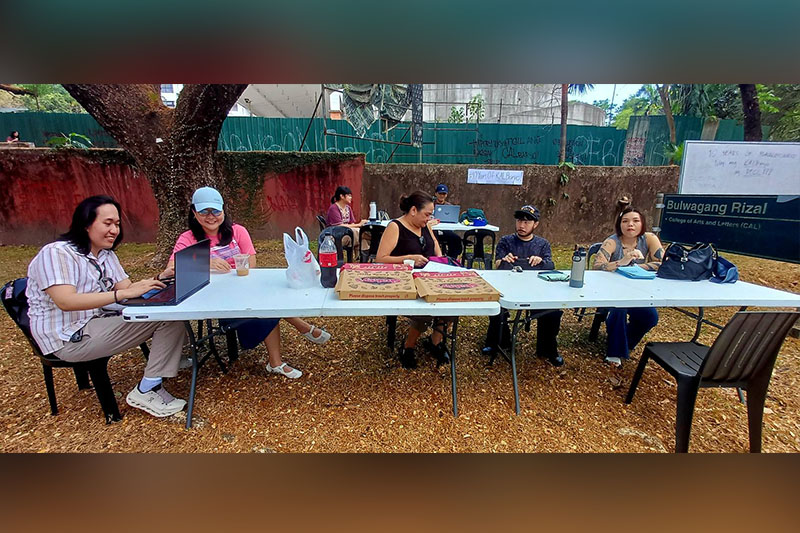



Faculty members from the University of the Philippines Diliman‘s English and Comparative Literature Department took their desks to the pavement to protest their spacelessness for 10 years after a fire gutted the Rizal Hall.
The UP College of Arts and Letters (CAL) said the intersection of Roxas Avenue and A. Roces Street on the campus was turned into a “makeshift academic hub” on Tuesday, April 7 as its faculty members protest their lack of facilities and accommodation.
It said that the outdoor demonstration marked the 10th anniversary of the fire that destroyed the Rizal Hall, also known as the Faculty Center, on April 1, 2016.
“For several hours, professors have been holding classes, marking papers, finalizing syllabi, and having consultations under the shade of the Academic Oval’s acacia trees, recreating the daily office grind in full view of the public,” the UP CAL said in a post.
The UP Department of English and Comparative Literature also posted about the protest with the title, “TULOY ANG #KALBARYO.”
“There is a profound irony in the continued expectation of excellence amid the growing absence of accommodation and institutional support. This irony resonates in the reality that a college home to several CHED Centers of Excellence remains itself without a proper home,” it said.
“At the heart of this protest—though by no means the only issue we confront amid the growing mistreatment under both the prior and current administration—is the placelessness that has haunted the College of Arts and Letters and the Department of English and Comparative Literature for a literal decade,” the department added.
It said the protest is meant to “draw attention to the shameful conditions of spacelessness” of the department’s faculty members, who are expected to hold consultations for students, prepare multiple classes, and produce research within a single classroom repurposed as an office.
“By occupying this space, we draw attention to the painful reality of carrying out office work without an office. By placing tables and chairs and performing our daily labor in the space where FC once stood and where the new Faculty Commons has yet to fully rise, we make visible how academic life is forced to continue despite the denial of dignity and the university’s disregard for its staff and students,” it said.
The department also shared testimonies of individuals who shared what they have lost in the fire 10 years after the incident.
These include research notebooks, paintings, diplomas and awards, books signed by esteemed writers, and their own spaces.
In the early morning hours of April 1, 2016, a fire ravaged the FC, formally named as Bulwagang Rizal, destroying faculty rooms and other offices, including multiple libraries, audio-visual rooms, and galleries.
The FC served as the home of the College of Arts and Letters (CAL) and the College of Social Sciences and Philosophy (CSSP).
The campus landmark also housed the Claro M. Recto Conference Hall, Teatro Hermogenes Ylagan, and the Institute of Creative Writing.
In 2024, the Philippine Collegian, the student publication of UP Diliman, reported about the faculty’s struggles of the lack of space, with some professors doing consultations on hallways instead for privacy.
“CAL faculty members are now up in arms over these supposed temporary conditions while construction of the new FC and CAL buildings continues to be delayed,” the report said.
“The new FC was supposed to be completed in 2020, while the latter should be done within this year. Both, however, are still far from being completed,” it added.