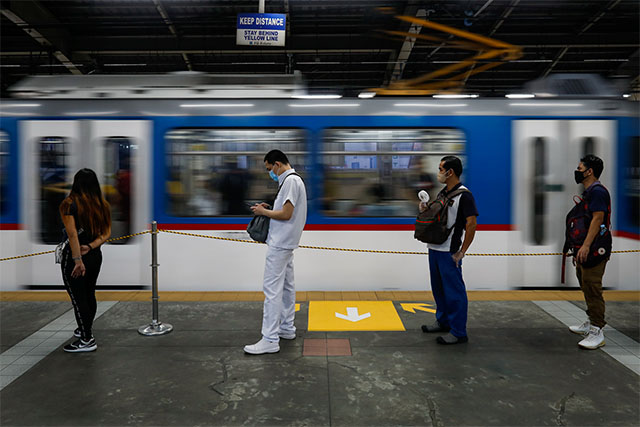



A train commuter has developed a mobile app aimed at helping busy passengers and persons with disabilities (PWDs) navigate Metro Manila’s rail system more easily.
Industrial designer Enrico Miguel Velasquez said he created TrenKo to make train commutes hassle-free for first-time riders, fatigued or preoccupied workers, and PWDs.
He described the app as a “smart train companion built for the Metro Manila rail system” that automatically detects the nearest station, tracks trips in real time, and notifies users of the number of stops remaining, transfer points, and other travel details.
Velasquez said TrenKo displays a user’s current station, nearby stops, and transfer information for commuters who need to switch rail lines.
The app notifies users when they are one station away from their destination and alerts them upon arrival at the station where they need to alight. It also shows how many stations remain and provides alerts for upcoming stops and transfers, helping users avoid missed exits.
TrenKo also allows commuters to view estimated fares for single-journey and stored-value tickets, including breakdowns for trips involving transfers.
Moreover, it alerts commuters if they are traveling in the wrong direction or if they miss their intended stop, providing instructions on how to reach their destination correctly.
The app also lets users receive station alerts, arrival reminders, and real-time trip progress via the iPhone’s Live Activities feature, even when their phone is locked.
Velasquez said TrenKo currently supports the MRT-3, LRT-1, and LRT-2 rail systems.
For now, it is available only on iOS through the App Store, though Velasquez hopes to release an Android version to make the app “more accessible for everyone.”
He added that one of his main goals in developing TrenKo was to give commuters “ease of access and information” so they can always know their location, even in crowded trains or while using their phones.
“Siksikan sa tren, usually mahina o maingay sa loob kaya hindi rinig ‘yung announcement (or naka earphones, lol) ta’s hindi ka rin naman makadungaw sa labas. So I’d just count stations in my head or look at the route map sa taas, hoping I wouldn’t miss my stop,” he shared in a Facebook post on Monday, January 26.
“After commuting almost daily, I kept wishing for ease of access and information para lagi akong aware of where I was kahit siksikan man or kung nagpho-phone lang tayo kapag medyo maluwag sa loob. That wish stayed with me, and it eventually led me to build TrenKo,” Velasquez added.
Velasquez said he built the app with first-time riders, busy or tired commuters, and PWDs in mind.
“Part of me built this app for my own personal goal of creating an app for our phones, but it’s also to help those na first time mag-tren, para dun sa mga pagod na sa trabaho at hindi na aware kung nasaang station sila, and for PWDs who could benefit from clearer, more accessible information,” Velasquez wrote.
Velasquez said he released the app now “to get real feedback from everyday commuters” so he can “continue improving accuracy and features based on real-world use.”
“If you know someone who commutes by train or could use an easier, less stressful ride, share this with them so they can try TrenKo,” he wrote.
Meanwhile, an online user who downloaded the app described it as “super helpful” for his commute.
“Nag no-notif siya kahit ‘di directly naka-open ‘yung app. Galingggg, Enrico!” an online user commented, sharing a screengrab of a notification they received on their phone.
Many people in Metro Manila rely on trains for their daily commute. Trains offer a convenient way to travel, often allowing riders to reach their destinations faster than other modes of transportation.