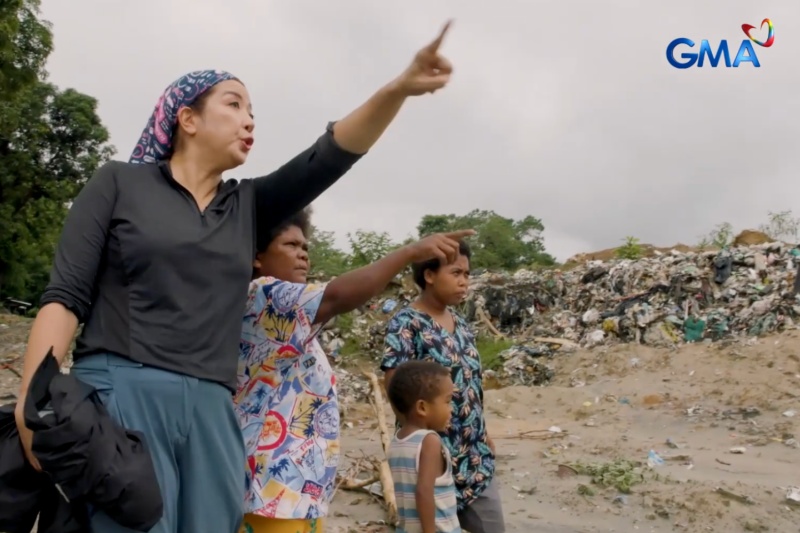



“Nakakakulo ng dugo.”
A documentary about an indigenous community’s home being turned into a trash dumpsite by the local government unit has drawn widespread outrage among Filipinos.
Journalist Kara David featured an Aeta community in Subic, Zambales, in her documentary for “I-Witness” that aired on Sunday, July 12.
Titled “Ibinasurang Paraiso,” the episode revealed how a portion of a mountain in Sitio Tibag was turned into a dumpsite by the LGU itself beginning in 2019.
It was supposed to be a temporary move, but it lasted for seven years.
David said the LGU dumped trash, including waste generated during the height of the COVID-19 pandemic, such as face masks and PPE suits, into a cliff.
The area was then filled with soil. The process continued for seven years, with the cliff nearly reaching the level of the mountain itself due to the accumulation of trash and soil.
The Department of Environment and Natural Resources (DENR) investigated the incident in 2022 and, by 2025, issued a cease-and-desist order against the Subic LGU.
Despite the order, the LGU has yet to retrieve the trash it has dumped in the area.
The area used to be a site where Aetas like Erlinda Capistrano would rest.
“Magandang lugar po ‘yun, ma’am. Doon po kami nagra-ranso… doon po kami nagpapahinga ‘pag nagabihan po kami bago kami aakyat dun sa lupa namin, doon po kami nagra-ranso po at doon po kami natutulog,” Capistrano told David.
Capistrano said the cliff used to be steep but had already been flattened by the dumping of trash and soil.
David was also told that a stream, which was were the Aetas used to get their water, had become contaminated by garbage leachate.
The Aetas said that the water’s smell and color had changed following the creation of the dumpsite.
According to them, they were still able to get shrimp from the water source, saying it was “extremely clean” at the time.
Another Aeta, Marites Gonzales, said the dumpers told them the mountain would be “beautified.”
Marian Del Castillo, municipal engineer of the Subic LGU, said they were looking for a place to dump trash.
She said the area appeared “isolated,” adding that no one seemed to be living there because it was a “forest.”
Mary Grace Molina, officer-in-charge of the Subic LGU’s Municipal Environment and Natural Resources Office (MENRO), also said they had “no idea” that there was a community in the area.
She added that they would not have pushed through with the initiative if they had known there was a community there.
David reported that the area was part of the Aeta’s ancestral domain, according to the LGU’s website.
The documentary generated buzz among Filipinos who expressed their anger over the dumping on the Aetas’ land.
“This is a crime under the Solid Waste Act and Clean Water Act. Because these violations are tolerated, it is no wonder why our floods keep getting worse each year,” environmental lawyer Galahad Pe Benito said.
“The Solid Waste Act is a law. It is not a mere recommendation that you may follow or disregard. If you don’t follow, you must face the consequences. Abolish na lang ang batas ‘pag ‘di rin lang susundin,” he added in another post.
“This needs to be seriously prosecuted by the DENR/Ombudsman. Show that the government is serious in giving meaning to the people’s right to a clean and healthy environment. Otherwise, it will be business as usual for LGUs violating [environmental] laws,” Pe Benito added.
“Grabe ‘yung ginawang kababuyan ng LGU where they used their powers para linlangin at paniwalain ang mga ayta na panandalian or temporary lang ‘yung pagtatambak pero umabot ng 7 YEARS!!!!” another Pinoy esaid.
“Nakakakulo ng dugo itong ginawang to sa bundok!!! Look how incompetent this LGU is! Ang daming violations tapos band-aid solution nanaman?! Like, tatabunan ng lupa para lang hindi makita ‘yung mga basura?!” a different Threads user said.
“The first question is always: Who let this happen? This would not have been possible without a go signal from DENR and/or local government. Hold them accountable,” a different Threads user commented.
Del Castillo said they need “at least P78 million” to rehabilitate the area following the DENR’s cease-and-desist order.
The LGU said the solution it could think of was to fill the dumpsite with soil.
When asked if they will remove the trash, Del Castillo said they would take “preventive” measures to prevent the garbage from contaminating bodies of water.