

“This does not make Manila great again.”
This was part of the appeal issued by advocates Renacimiento Manila and Save Arroceros Movement, which sent a letter to Manila Mayor Isko Moreno Domagoso requesting the local government unit to stop the cutting of trees for the construction of the Southern Access Link Expressway (SALEX).
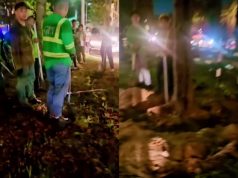
“Na para pong literal na dumudugo pa,” GMA News reporter Mark Salazar said in the video.
He then said the narra tree was among 225 trees cut in the area to make way for a Skyway-related project.
“Pero gaya nga ng sinasabi ng mga environmentalists, hindi naman kaya palitan ng gaano karaming seedlings ang isang matandang puno na nandito na deka-dekada na nagbibigay ng benepisyo,” Salazar said.
“More than 600 trees were permitted by DENR to be cut along Quirino Avenue in Manila to give way for Skyway project. Some call it a necessary sacrifice for urban development, others call it a massacre of nature,” he captioned his post.
View this post on Instagram
Salazar’s video garnered 84,200 likes, 35,000 reposts and over 4,900 comments, many of which condemned the tree-cutting.
“IIYAK NA NAMAN SA BAHA,” an Instagram user wrote.
“DENR — Destruction of Environmental and Natural Resources,” another commented.
“Fcking DENR!! ‘Yung puno mismo is history itself, now gone. Ang sakit sa puso,” a different Pinoy wrote.
“One of the reasons why we left Manila. We love walking down Quirino all the way to Malate when the narra trees were blooming and we were constantly showered by its golden petals and its subtle fragrance. I am glad I made a whole album in FB [Facebook] about this. Now, it is just a memory,” another commented.
What the DENR said
In response to concerns about the tree-cutting, the DENR assured the public that it is enforcing all safeguards in the operations.
It explained that the tree cutting is part of the construction of SALEX, which will connect the Skyway to Roxas Boulevard.
The agency added that it is “closely supervising every phase of the activity and enforcing all safeguards” in relation to the tree-cutting work.
“Our priority is to protect communities, uphold the law, and ensure that the environment gains more than it loses,” it said.
“We assure the public that no tree is authorized for removal without strict legal basis, environmental safeguards, and long-term rehabilitation requirements,” the DENR said.
The agency also addressed a similar activity in Palawan called the “Berong Nickel Project.”
“For the Berong Nickel Project — Tree Cutting and Earth-Balling Permit, a total of 26,617 trees were authorized for cutting and 43,743 saplings were approved for earth-balling and transplanting,” it said.
“Importantly, the cutting of trees in Berong will not occur in one instance. It will be implemented in phases, and each phase will proceed simultaneously with the planting of replacement trees to ensure continuous ecological recovery,” the DENR added.
“The project carries one of the highest mitigation standards in the country, including a mandatory replacement ratio of 100 indigenous seedlings for every tree authorized for cutting —equivalent to an estimated minimum of 2,661,700 seedlings,” it continued.
The DENR said the seedlings “must consist of indigenous and mangrove species such as Pagatpat, Api-api, and other DENR-approved native species suited to the area’s rehabilitation needs.”
It added that proponents are also required to “maintain all planted seedlings for at least three (3) years to ensure survival and successful establishment,” as well as “to continue long-term protection and stewardship of the rehabilitated areas thereafter.”
“The company must also engage local communities and families to carry out planting, maintenance, and protection activities—subject to DENR validation before any payment is released to the community to ensure transparency, quality of work, and community benefit,” the DENR said.
The agency also said the project must also maintain 20-meter buffer zones along rivers and waterways, rehabilitate non-minable and protection areas, submit geo-tagged monitoring reports and comply with strict monitoring protocols conducted by its professional foresters.
“We ask for the public’s calm and continued engagement as we carry out our mandate with transparency and care,” the DENR concluded.
— With Rosette Adel