

Palawan residents expressed concern over a rocket launched by China on Monday, August 4, which caused a loud, explosive noise.
The Philippine Space Agency (PhilSA) on Monday confirmed that Beijing launched its Long March 12 rocket from the Hainan International Commercial Launch Center in Wenchang, Hainan, at around 6:21 p.m.
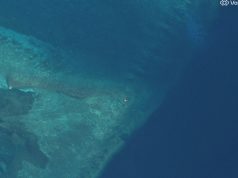
PhilSA added that expected debris from the launch was projected to have fallen within the identified drop zones approximately 21 nautical miles from Puerto Princesa City and 18 nautical mile from the Tubbataha Reef Natural Park.
The Tubbataha Reefs Natural Park is a marine protected area and world-renowned scuba diving site. Estimated to be over 97,000 hectares in size, the waters are also home to over 1,200 marine species.
PhilSA also cautioned the public against retrieving or coming into close contact with the debris, warning that it may contain toxic substances such as rocket fuel.
“Unburned debris from rockets, such as the booster and fairing, are designed to be discarded as the rocket enters outer space,” PSA said.
“While not projected to fall on land features or inhabited areas, falling debris poses danger and potential risk to ships, aircraft, fishing boats, and other vessels that will pass through the drop zone. There is also a possibility for the debris to float around the area and wash toward nearby coasts,” it added.
The public was also advised to promptly report any suspected debris sightings on land or at sea to local authorities.
The National Disaster Risk Reduction and Management Council (NDRRMC) also urged government agencies to consider temporary restrictions and issue advisories in the identified drop zones.
The incident alarmed some residents of Palawan, who reported hearing a loud, explosive noise. Some compared it to thunder, while others said it felt like the ground shook from the booming sound.
“Dito po sa amin ang sobrang lakas ng pagsabog around 6:38 p.m. sa Plaridel, Aborlan, Palawan,” a Facebook user commented.
Aborlan is around an hour’s drive from Puerto Princesa City — one of the landmasses nearest to the identified drop zone of the rocket.
“Kahit [dito] sa Batang-Batang, Narra, malakas putok,” another commented.
“Kanina ang lakas, parang may sumabog sa ilalim ng lupa,” a different Pinoy shared on Monday.
“Akala ko malakas na pagbagsak ng ulan, ‘yon pala rocket na pala ‘yun. Rinig na rinig namin mula Adventist Hospital eh… magdasal po [tayo lahat],” another wrote, referring to a hospital in Puerto Princesa City.
“Ang lakas ng pagsabog,” another Pinoy shared.
“Yanig bahay namin,” a different online user wrote.
“Akala ko lang ay kulog, pero sa isip parang kakaibang kulog kaya medyo ang naisip ko lang may bago na naman. [Kailannga] talaga maging mapagmanman tayo sa mga galaw ng China. Lalo na dito sa Palawan,” another commented.
“Mabilis mamatay [‘yung may] sakit sa puso sa ginagawa nila,” a different Pinoy wrote.
“Saan po galing putok kanina mga sir or ma’am, kasi bigla po kaming nagulat sa lakas ng putok. Nakakatakot po naman,” another said.
“Ay hala, narinig namin ‘to, yumanig talaga. Sabi namin baka bomba nga… lakas e, ingat po, kapwa ko Palawenyo, let’s pray together po na maging safe po tayo,” a different Pinoy commented.
Palawan News reported that some residents described the sound “as similar to a loud drum exploding twice.”
“Others said it was thunderous and felt like it shook the ground. A few reported seeing one end of the falling object on fire as it streaked across the sky,” the local publication said.
China Daily said that the Long March 12 rocket launch was meant to send “a group of internet satellites into space.”
“It successfully placed the payloads, the seventh group of low-orbit internet satellites, into preset orbit,” it reported.
Philstar.com reports that the rocket launches are part of China’s rapidly expanding space program, driven by military ambitions, commercial interests, and plans to build massive satellite internet constellations that can, among others, compete with SpaceX’s Starlink. — with reports from Philstar.com/Cristina Chi