


- KOSPI on track for worst week since early March
- Thai baht set for seventh decline in eight sessions
- Malaysian ringgit strengthens 0.4%
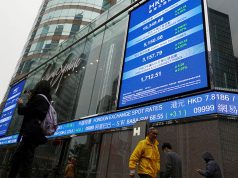
Asian stocks took a fresh hit on Friday after Apple’s <AAPL.O> price hikes rattled tech sentiment, sparking a selloff in tech-heavy markets such as South Korea and Taiwan and reviving doubts about the durability of the AI-driven rally.
The MSCI Emerging Markets Asia gauge <.MIMS00000PUS> fell nearly 4%, hitting its lowest point since June 12. For the week, the index has lost more than 5% so far, on track for its worst since the first week of the Middle East conflict.
South Korea’s KOSPI <.KS11> fell 8%, prompting the regulator to impose a temporary trading curb.
The index, which has been one of the biggest beneficiaries of AI-related inflows so far this year, lost 7.6% this week. KOSPI is also on track for its worst week since the week ended March 6.
Apple raised iPad and MacBook prices on Thursday, saying it could no longer shield customers from soaring memory and storage chip costs driven by the AI industry’s datacenter buildout.
“Apple’s sudden price hike has become a reality check for AI trades,” said Glenn Yin, director of research at brokerage ACCM.
“Investors are beginning to ask who is ultimately bearing the cost, rather than just celebrating growing semiconductor demand, and if a significant part of that cost is being passed onto consumers, then demand elasticity could become the next constraint on AI-related earnings growth.”
Taiwan shares <.TWII> fell as much as 2.3% to their lowest level since June 17, putting the market on track for its worst weekly performance since early March.
Across Southeast Asia, Singapore stocks <.STI> fell 1%, while those in the Philippines <.PSI> traded 0.6% lower.
Stocks in Jakarta <.JKSE> shed more than 1.5%, and Thailand’s benchmark <.SETI> lost over 1%.
Regional currencies also weakened on Friday, pressured by expectations that the Federal Reserve will keep interest rates elevated and by a broadly stable U.S. dollar.
The dollar inched lower but remained on track for its first back-to-back weekly gain since the start of the Middle East conflict on February 28.
“The combination of strong U.S. data and delayed Fed easing continues to underpin the dollar through favorable rate differentials,” MUFG analysts wrote in a note.
“Most Asian currencies still face relatively lower, and in some cases widening, yield differentials versus the U.S., limiting scope for sustained appreciation.”
The Indonesian rupiah <IDR=> traded 0.2% lower, still hovering around the key 18,000 mark against the dollar.
The Thai baht <THB=TH> shed as much as 0.5%, hitting its lowest level since May, and was on track for a seventh decline in eight sessions.
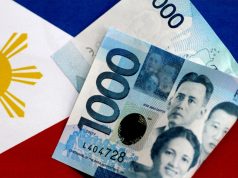
Bucking the broader weakness, Malaysian ringgit <MYR=> strengthened 0.4%, while the Phillippine peso <PHP=> was largely flat.
HIGHLIGHTS:
** Core inflation in Tokyo accelerates as energy-driven price pressures begin to broaden
** Bangladesh urges China to reduce trade gap
** UN halts escort of ships through Hormuz after vessel comes under attack
| Asia stock indexes and currencies at 0441 GMT | ||||||
| COUNTRY | FX RIC | FX DAILY % | FX YTD % | INDEX | STOCKS DAILY % | STOCKS YTD % |
| Japan | <JPY=> | +0.13 | -3.05 | <.N225> | -4.35 | 37.54 |
| China | <CNY=CFXS> | -0.05 | +2.73 | <.SSEC> | -2.14 | 1.60 |
| India | <INR=IN> | – | -4.79 | <.NSEI> | – | -7.94 |
| Indonesia | <IDR=> | -0.19 | -7.13 | <.JKSE> | -2.73 | -32.52 |
| Malaysia | <MYR=> | +0.41 | -1.02 | <.KLSE> | -0.18 | -1.14 |
| Philippines | <PHP=> | +0.04 | -3.99 | <.PSI> | -0.42 | -0.12 |
| S.Korea | <KRW=KFTC> | -0.20 | -6.90 | <.KS11> | -7.93 | 95.10 |
| Singapore | <SGD=> | -0.05 | -0.80 | <.STI> | -1.10 | 11.09 |
| Taiwan | <TWD=TP> | -0.16 | -1.41 | <.TWII> | -2.58 | 55.58 |
| Thailand | <THB=TH> | -0.30 | -5.89 | <.SETI> | -0.92 | 22.59 |
—Reporting by Rajasik Mukherjee in Bengaluru; Editing by Sherry Jacob-Phillips