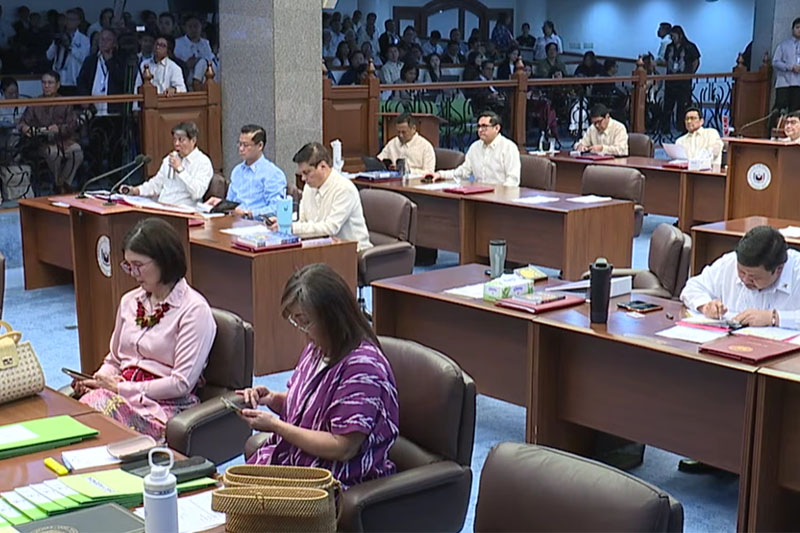



The meaning of the phrase “force majeure” became a point of discussion after the Senate’s rules on remote participation were brought to light following the majority bloc’s proposal.
Sen. Rodante Marcoleta proposed amending the Upper Chamber’s rules on teleconferencing amid concerns of the members of the Senate majority.
Sen. Chiz Escudero is facing plunder charges before the Ombudsman in connection with the flood control scandal. He has since denied the allegations.
The Ombudsman has also said that Sens. Jinggoy Estrada and Joel Villanueva may be charged over the same issue.
Meanwhile, Sen. Ronald “Bato” Dela Rosa, another member of the majority, remains missing after fleeing the Senate compound on May 14 after the shooting incident.
He rode in Sen. Robin Padilla‘s vehicle and was later dropped off in Makati.
The Philippine National Police and the National Bureau of Investigation have since conducted search operations in three locations following the Department of Justice’s order to implement the International Criminal Court (ICC) arrest warrant.
Dela Rosa is currently tagged as an “indirect co-perpetrator” in the Duterte administration’s “war on drugs” campaign and is accused of committing the “crime against humanity of murder” between July 2016 and April 2018 for his role as PNP chief.
He emerged in the Senate on May 11 to participate in a vote that ousted then-Senate President Tito Sotto III and installed then-Senate Minority Leader Alan Peter Cayetano in the position.
Dela Rosa admitted that Cayetano called him to participate in the vote.
Following these incidents, Marcoleta proposed amending the Senate’s rules to allow colleagues who cannot be physically present to participate remotely in sessions.
The move comes before the Upper Chamber officially begins its impeachment trial of Vice President Sara Duterte in July.
The insistence on discussing the proposal has led to a walkout by the Senate minority, who said the move “appears to be an attempt to rush a major change in the Senate Rules.”
“We walked out because what happened on the floor looked less like orderly deliberation,” they said in a joint statement.
“The proposed rule change affects how senators may attend sessions, participate in proceedings and exercise their mandate through remote means, and such a measure should be opened to healthy public debate instead of being rushed by the tyranny of the majority,” the minority bloc added.
Comparisons were also made to Rep. Leila de Lima‘s case during the COVID-19 pandemic, when proposals were raised to allow her to participate remotely in Senate sessions while she awaited the resolution of the drug trafficking charges against her.
The comparison, however, was rejected by Sens. Risa Hontiveros and Kiko Pangilinan, who argued that there was a public health emergency at that time due to the COVID-19 pandemic. They also pointed out that De Lima was not actively evading the law.
Under Senate Rules, the Senate president may convene and hold a session only through “teleconference, video conference, or other reliable forms of remote or electronic means” due to “force majeure or the occurrence of a national emergency.”
Padilla, who helped Dela Rosa flee the Senate compound, argued that the conflict in the Middle East and the Philippines’ involvement in tensions between China and Taiwan could be considered “force majeure.”
Force majeure defined
“Force majeure” refers to “an event or effect that cannot be reasonably anticipated or controlled” or “the state or an instance of being unable to fulfill an agreement due to such an event or effect.”
Hontiveros said the circumstances raised by Padilla do not constitute “force majeure,” adding that such events do not require lawmakers to shift to remote sessions.
Former COA (Commission on Audit) commissioner Heidi Mendoza also shared an infographic explaining the meaning of the term.
Grabe. Ang pinakasukdulan talaga ay yung tangang mayabang.
Maipasok lang ang sariling katwiran, gagamitin na ang batas na parang goma — iuunat, pipilipitin, babaluktutin — para lang mapaboto ang katotong pinaghahanap ng hustisya.
Sorry, patola ako ngayon, kasi hindi ko talaga… pic.twitter.com/7mmEF3HSwG
— Heidi Mendoza (@HeidiMendoza45) May 28, 2026
Article 1174 of the Civil Code of the Philippines describes force majeure as events “which could not be foreseen, or which, though foreseen, were inevitable.”
In the 1986 Supreme Court ruling in Nakpil & Sons v. Court of Appeals, the court said that “force majeure” applies when an event is beyond a person’s control, unavoidable or unforeseeable, and makes it impossible to fulfill obligations in a normal manner.
— with reports from Philstar.com/Geraldine Santos