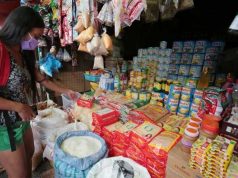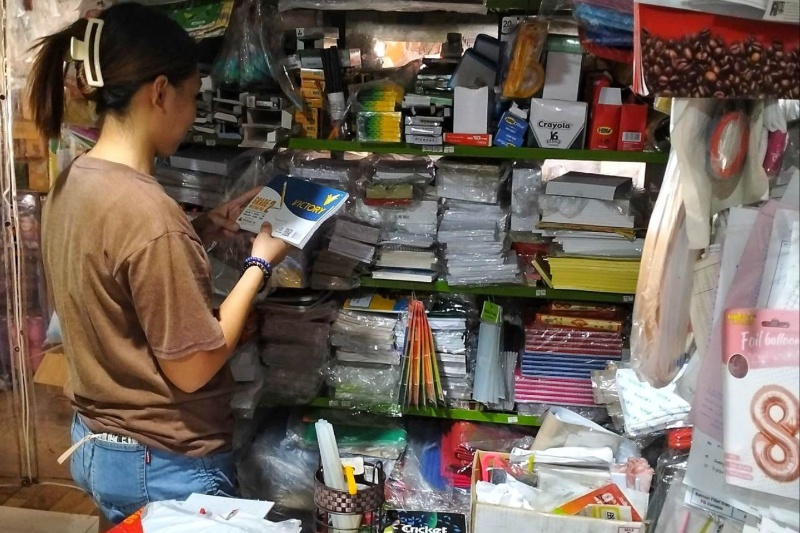


As the new school year opens, sari-sari stores across the Philippines are expanding their inventories to offer “tingi,” or small quantities, of school supplies.
This trend was highlighted by Filipino tech startup Packworks, which analyzed over a million monthly sales transactions from its network of more than 300,000 sari-sari stores nationwide through its mobile app and business intelligence tool, Sari IQ.
Data from Packworks showed that the number of stores located near schools, within 400 meters or roughly 500 steps, grew by 31%, from around 71,000 in 2023 to 95,000 last year.
As of June 2025, the company has 102,058 partner stores operating near schools.
Most of these are in rural regions, including Zamboanga Peninsula (+77%), Cordillera Administrative Region (+70%), Northern Mindanao (+55%), Eastern Visayas (+52%), and Western Visayas (+50%).
Sales trends indicate that sari-sari stores are benefiting from strategic inventory adjustments during the back-to-school season.
In 2023, stores saw a 30% boost in August, coinciding with the August 29 start of the school year. This surged to 130% in July 2024, ahead of the July 29 school opening. For 2025, stores recorded a 71% spike in June, as the school year kicked off on June 16.
Packworks Chief Data Officer Andoy Montiel explained that the data points to a trend of more frequent but smaller purchases, citing that the country’s “tingi economy” extends beyond household commodities.
“The contradiction between the increase in sales transactions and the decrease in the overall GMV between 2023 and 2024 indicates that sari–sari stores, especially those in rural areas, are not just participating in the back-to-school season but strategically adapting to it with a model that works for their communities,” Montiel said.
The accessibility of small-quantity purchases is particularly important, as educational costs, including school supplies, can make up more than half of a typical Filipino household’s monthly income.
Regions with the highest growth in gross merchandise value (GMV) from 2023 to 2024 included Bicol (+381%), Northern Mindanao (+256%), Cagayan Valley (+120%), Western Visayas (+87%), and SOCCSKSARGEN (+78%). So far in 2025, stores have generated P795,000 worth of GMV in the first six months alone.
Packworks Chief Platform Officer Hubert Yap added that sari-sari stores demonstrate strong entrepreneurial skills in responding to seasonal demand. He called the sari-sari stores a “lifeblood of the Philippine economy.”
“They are not just reacting to demand, but they are strategically positioning themselves and adapting to the needs of their communities, especially with the recent long suspensions of the first weeks of public school due to the torrential rains this season, ensuring neighborhood educators, parents and students have access to what they need, exactly when they need it, just in time for the back to school rush,” Yap said.
Top-selling items among school supplies include pad paper (+74%), colored pencils (+74%), bond paper (+71%), paper glue (+28%) and correction tape (+23%).
“Our report also serves as a valuable roadmap for brands and education services to realize their hyper-targeted market opportunities in partnering with sari–sari stores to effectively reach local communities,” Yap added.