
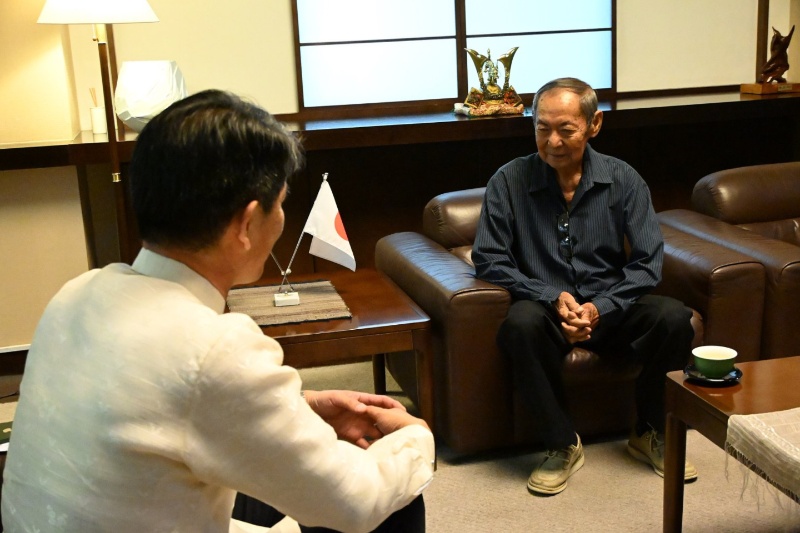

As part of its efforts to help Filipino-Japanese descendants acquire Japanese nationality, the Ministry of Foreign Affairs of Japan facilitated the visit of Jose Takei, allowing him to reunite with his family after decades of separation due to war.
According to a report of Asia News Network, 82-year-old Jose, born in 1943 to Benita Abril and Ginjiro Takei, an engineer for the Philippine National Railway, was left behind in the Philippines at the end of World War II. He currently resides in San Pablo, Laguna.
On Wednesday, August 6, the Ministry of Foreign Affairs of Japan arranged his trip so he could fulfill his plan to meet his siblings living in Osaka and visit the grave of his father, Ginjiro.
Before his departure, he visited the Embassy of Japan in the Philippines for a pre-departure engagement with the members of the Japanese press and met with Ambassador Endo Kazuya.
On the day of his departure, in the early morning of Wednesday, Jose was sent off by Deputy Chief of Mission Matsuda Kenichi at the Ninoy Aquino International Airport.
“A heartfelt send off for Mr. Takei Jose! As a remaining or Nikkei-jin in the, his travel to Japan is sponsored by the Japanese gov’t,” Endo also wrote on X (formerly Twitter).
“We reaffirm our support for the swift restoration of his Japanese nationality, & wish him the best on this important journey,” he added.
A heartfelt send off for Mr. Takei Jose! As a remaining 🇯🇵 or Nikkei-jin in the 🇵🇭, his travel to Japan is sponsored by the Japanese gov’t. ✈️ We reaffirm our support for the swift restoration of his Japanese nationality, & wish him the best on this important journey. pic.twitter.com/cbw1tJdsqp
— Ambassador of Japan in the Philippines (@AmbJPNinPH) August 5, 2025
Jose’s visit to Japan is part of the Japanese government’s broader initiative aimed at helping more Filipino-Japanese descendants in the Philippines. It added that similar arrangements will be made for others in the future, depending on need.
The efforts come as Japan continues to address historical and legal concerns surrounding children born to Japanese nationals and Filipinos, especially those separated from their Japanese parent due to wartime or post-war circumstances.
In August last year, Jose also met with the officials from the Embassy of Japan in the Philippines to share his experiences and hardships as a second-generation Filipino Nikkei-jin (Filipino-Japanese descendant) over the years.
The embassy then vowed to take efforts and help these Filipino-Japanese descendants to reclaim their identities and reunite with their long-lost relatives.
Asia New Network reported that there were an estimated 372 second-generation Japanese-Filipinos without Japanese nationality as of the end of March, with an average age of 83.